



- Thread Author
- #1





- Joined
- Sep 25, 2023
- Messages
- 36,940
- Reaction score
- 3,022
- Trophy Points
- 180
- Location
- Philippines
- D Bucks
- 💵8.379050
- Referral Credit
- 100
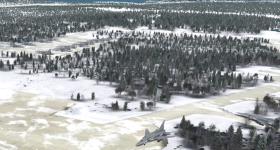
According to the report, Aechelon Technology has completed a proof-of-concept that uses AI and Vantor’s global 3D terrain data to turn ICEYE’s high-resolution radar imagery into detailed 3D synthetic environments.
The report also stated that the system fused radar detections of objects and changed on the ground with Vantor’s continuously updated 3D maps, which included terrain and building footprints covering more than 95 percent of the Earth’s landmass.
The report also said that Vantor supplies the data through its Tensorglobe platform, supported by a satellite constellation that can revisit the same area up to 15 times per day. Aechelon’s AI models process vegetation, turn building footprints into 3D structures, and match radar detections to create real-time representations of moving targets or new structures.
In addition to the report, AI features can even simulate environmental effects such as snow accumulation. In a military context, the capability could provide commanders with near real-time, 3D battlefield awareness, allowing them to track troop movements, identify potential threats, and plan operations with greater accuracy.
Source: Military AI

The report also stated that the system fused radar detections of objects and changed on the ground with Vantor’s continuously updated 3D maps, which included terrain and building footprints covering more than 95 percent of the Earth’s landmass.
The report also said that Vantor supplies the data through its Tensorglobe platform, supported by a satellite constellation that can revisit the same area up to 15 times per day. Aechelon’s AI models process vegetation, turn building footprints into 3D structures, and match radar detections to create real-time representations of moving targets or new structures.
In addition to the report, AI features can even simulate environmental effects such as snow accumulation. In a military context, the capability could provide commanders with near real-time, 3D battlefield awareness, allowing them to track troop movements, identify potential threats, and plan operations with greater accuracy.
Source: Military AI